Contents
Introduction
This piece was born one afternoon as I studied the seconds ticking by on a wall clock, neatly marking off my mortal span in increments uniform and unrelenting. The clock possessed a stark black face, with plain hands and no numerals. Silver-grey tick marks. It marks the passage of time in my childhood bedroom (or a recreation of it, a room of Theseus, essence intact through several moves) in Delhi, India. It had been ticking on in solitude for seven years since my last visit to India.
I imagined freezing a moment by tearing the second handaI remember being surprised when I learnt that a second is called a second since it is the second division of the hour. off the centre post and propping it against the endpoints of the major hands to form a triangle — a flying buttress against entropy’s march. This flavour of operation, translating transience into a crystalline stasis, lies at the heart of several different projects I’ve worked on over the years.
Construction
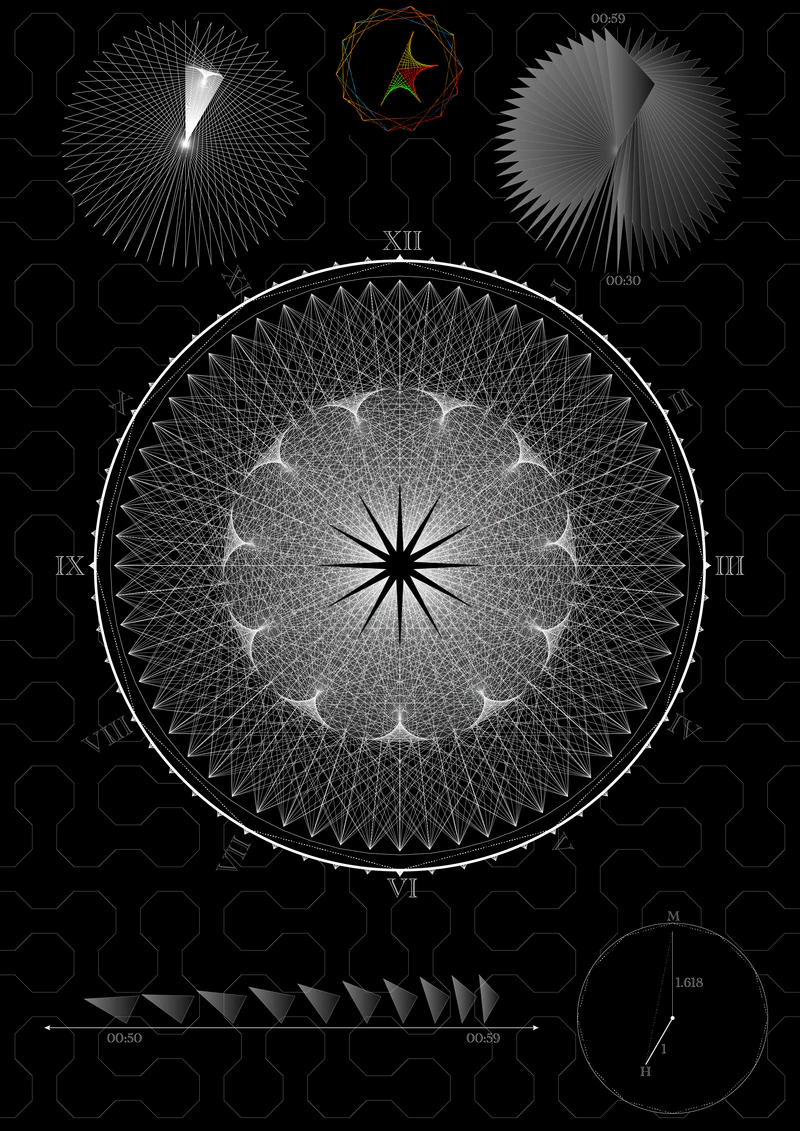
When I got around to capturing the idea with code, I abandoned the second hand and considered an elastic expanse of webbing between the major hands. The fabric of reality stretched between the defining termini. The animation above brings out the resemblance to watching a sundial time-lapse. Parametric generation of the triangles involved some trigonometry and modular arithmetic. I employed the golden ratio for the lengths of the hands.
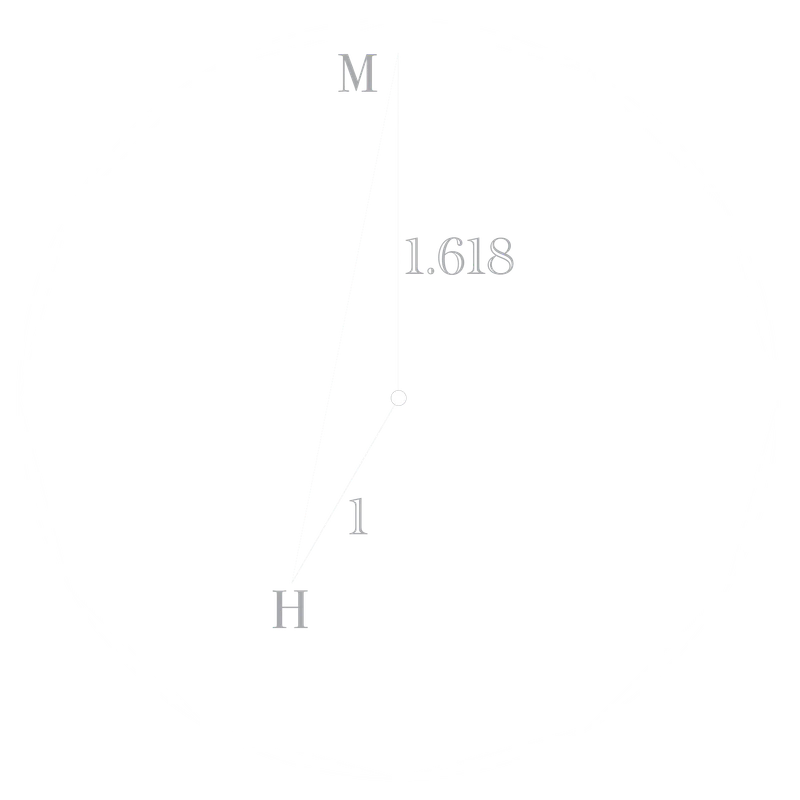
I used a dashed dodecagon to mark the boundary of the clock, with vertices marking each hour, inset within a circumscribing circle. I chose 07:00 for the illustrative example since 7 is my favourite single-digit number. The font for the numerals across my visuals is often Academy Engraved LET, while other labels are in Bodoni Small Capitals. This image also serves as the cover image for my digital diaries, which I take the time to typeset neatly and reflect on annually.
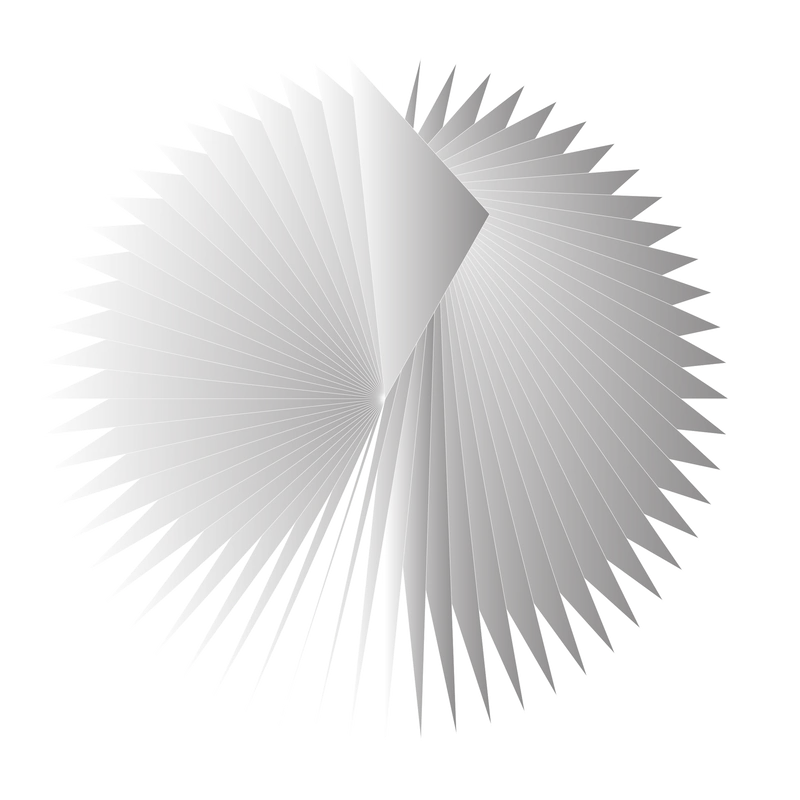
There is a tactile quality to time represented in this manner. Layers of triangles stacked on top of each other, separable into discrete units. Each hour has sixty, one for each minute. Because the hour hand creeps forward while the minute hand sweeps round, no two minutes in twelve hours give the same triangle merely turned about the centre, and only twice — at 00:00 and 06:00 — does it collapse into a line. The transparency of the gradient fill means the ordering is visually preserved in the overlay.
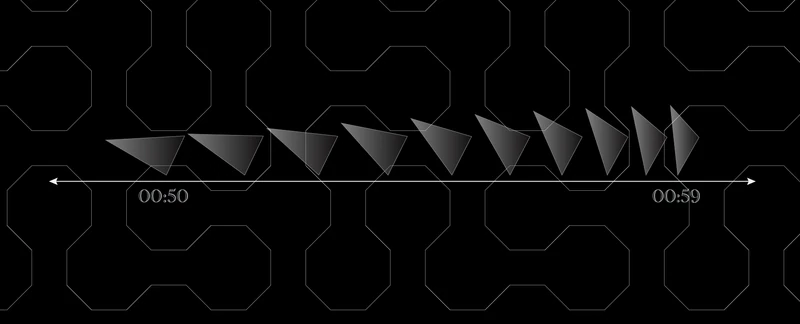
The linear timeline view takes the triangles from their original radial arrangement and lays them out sequentially. A prime motivating factor for this visual was to visualise timestamped data.
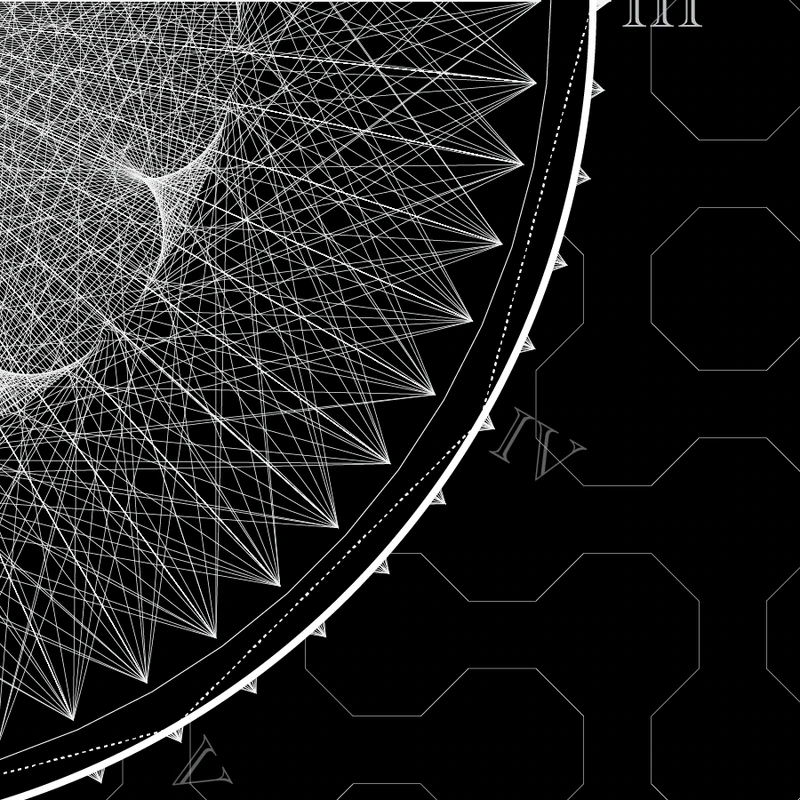
Over the course of a full twelve-hour cycle, the overlapping triangles trace out a complex pattern reminiscent of spirograph designs. The dark background has a space-filling curve overlaid on it.1 The curve winds its way through the negative space, capable (at higher iterations) of transiting through every pixel on the canvas.
The roots of this visual lie in a sketch I made years ago on graph paper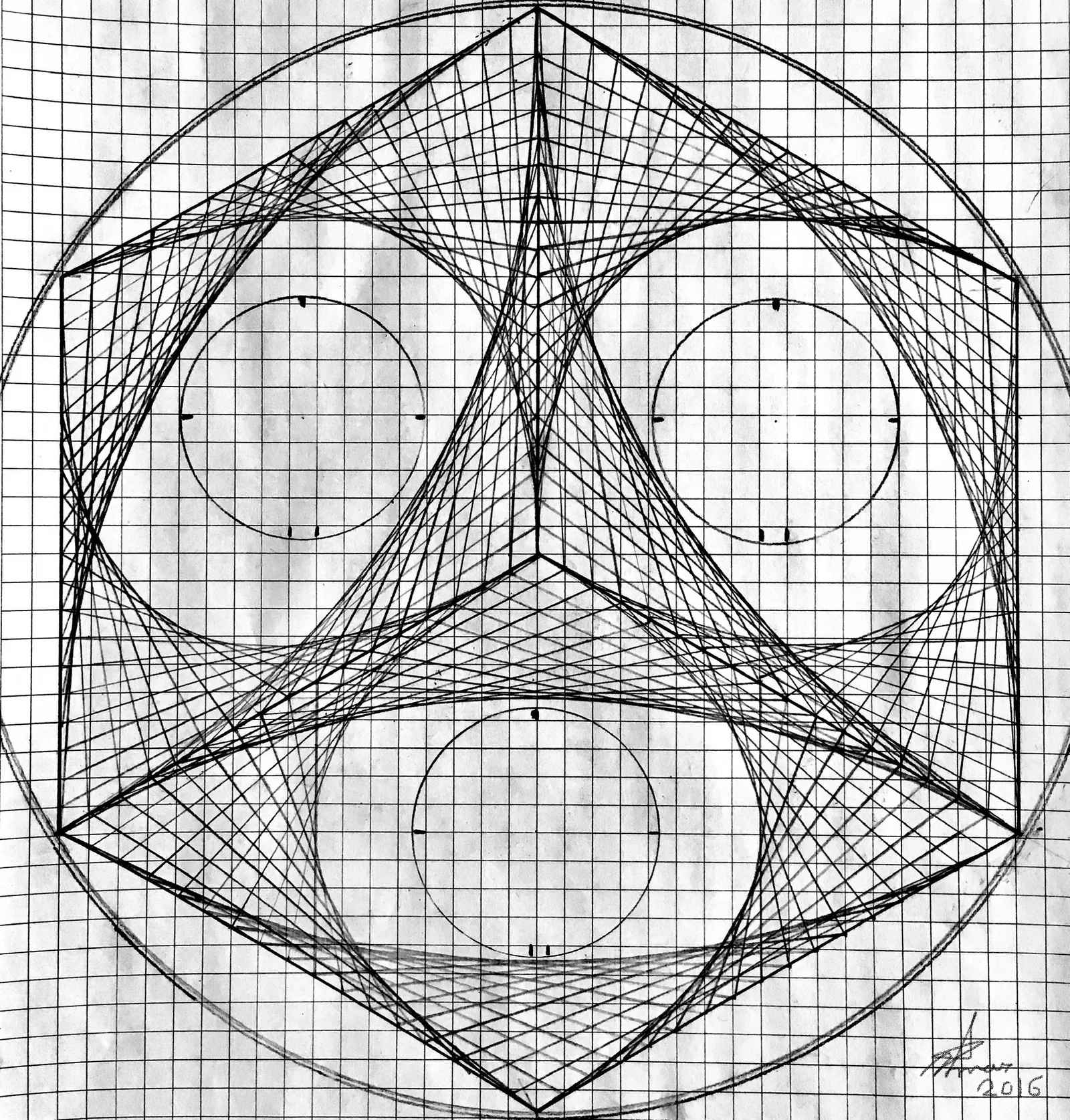 Figure i. Graph paper sketch, 2016. Each of the three circles was meant to contain a clock set to a different time zone..
Conclusion
In the sunset of dissolution, everything is illuminated by the aura of nostalgia, even the guillotine.2 Milan Kundera, The Unbearable Lightness of Being
I credit my teenage fondness for Kundera’s novels to the author’s meditations on memory and time. The past, the present, the future in an uneasy dance; causality blurred by the fallibility of recollection and the prophetic impulse of anticipation. ‘Einmal ist keinmal’ — once is never. Nietzsche’s eternal recurrence.
Despite the general geometric austerity of this visual, within its central motif lies a whole life: every minute of every day from first breath to last captured ‘in a network of lines that enlace, in a network of lines that intersect, on the carpet of leaves illuminated by the moon around an empty grave – what story down there awaits its end?’3