Introduction
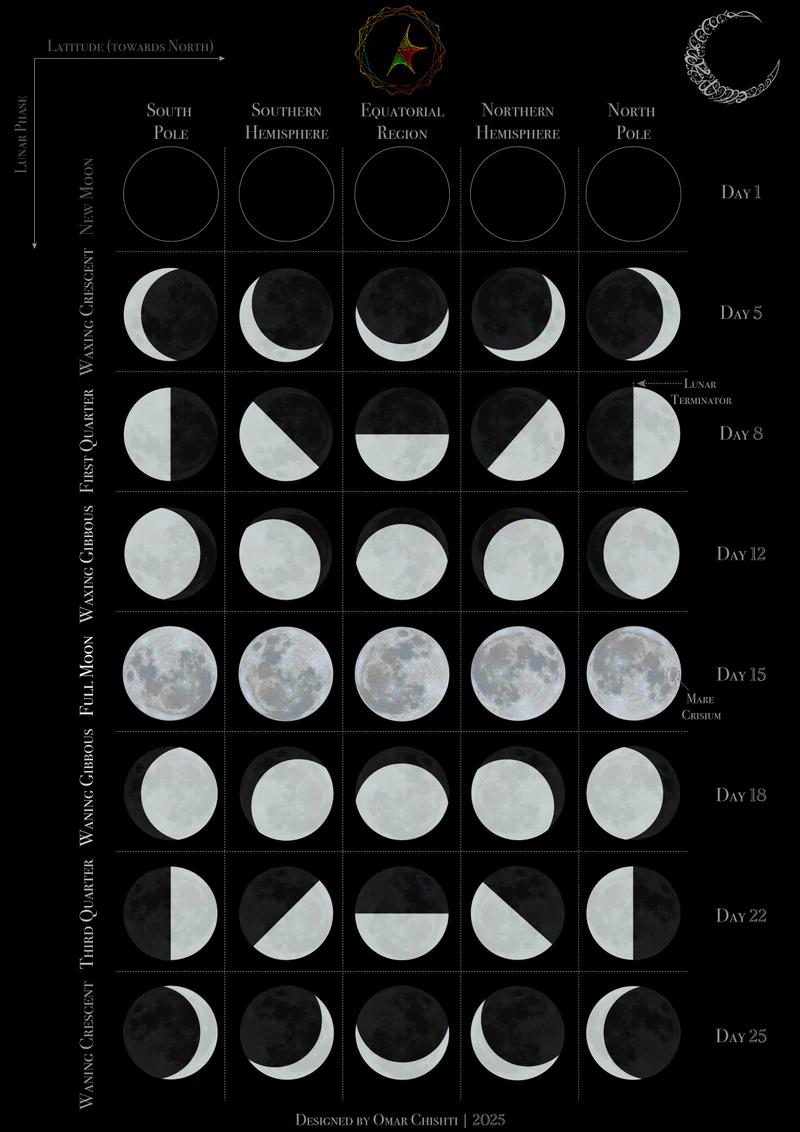
This piece is a guide for how the perceived orientation of a lunar phase differs depending on our latitudinal position on the planet. This might help understand variation in moon symbology across different cultures. It comes out much better in print form than the other version (Figure 4), with a Bauhaus sort of appearance.
Orientation
A useful heuristic one can apply while trying to figure out whether the moon is waxing or waning is examining the right side (if in the Northern Hemisphere) or the left side (if in the Southern Hemisphere). It is that side which shows what is growing. Light on the right side [in the north] signifies waxing, while darkness on the right side signifies waning.
The First Version
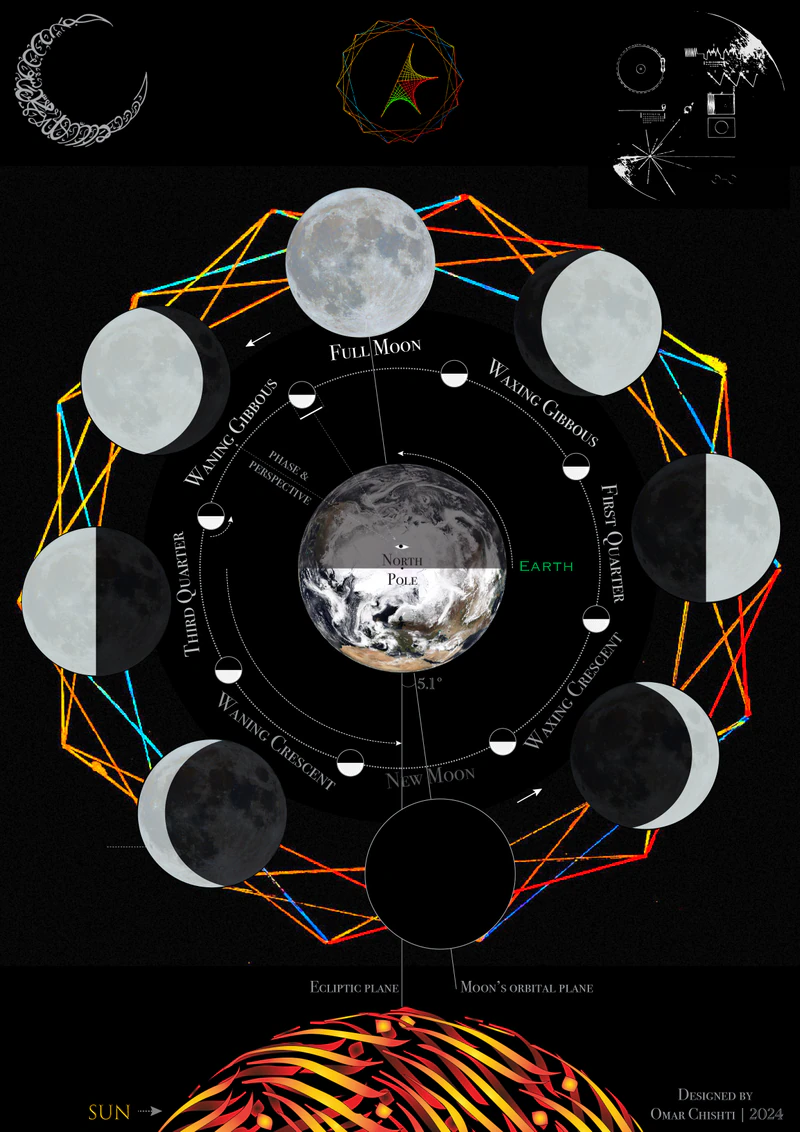
The elements are simple, mostly reused from the piece on the solar system. I used an expanded version of the sketch I use as my logo (metallic ink, Strathmore black paper, 2022) behind the phases (Figure 4, left) to hint at the irregularities of these simplified regularities.
The labels marking the eight phases are in varying shades to reflect the variance in illumination over the lunar cycle. The typical symmetric octagonal representation is tilted five degrees askew to capture the key to deciphering some of the central mysteries of the orbital mechanics: the tilt of the Moon’s orbital plane with respect to the Earth’s ecliptic planeaThe ~5° tilt means eclipses occur only when a New or Full Moon is near a node, where the two orbital planes intersect.. Ecliptic, eclipse — for if this tilt did not exist, every New Moon would cause a solar eclipse and every Full Moon would be a lunar one.
Sacrifices must be made while creating a static two-dimensional figure to represent a four-dimensional dance between three celestial partners. Aside from introducing the skew, I have followed centuries of convention. If you are interested in an in-depth three-dimensional explanation that benefits from the toolsets of modernity, I highly recommend this inimitable post by Bartosz Ciechanowski.1 I also took some inspiration from the horological design of moon phase complications in watchesbIn horology, a ‘complication’ is any function beyond simple timekeeping. Moon phase complications typically use a 59-tooth gear and display the current lunar phase through an aperture..
One of the reasons I made this infographic is the widespread indifference regarding our closest astronomical companion noticed on my own orbit around the planet. Our ancestors worshipped the moon, studied it closely, and drew calendars based on its periodicity. From the swelling of the tides to the name for the little crescents on your fingernails (lunulae), the influence of the moon permeates existence. Nevertheless, much of humanity today barely seems aware that the moon rises and sets on a daily basis, just like the sun, or that across the phases it spends as much time in the sky during the day as it does at night.
I used the left eye of Horus (𓂀)cIn Egyptian mythology, Horus’s left eye represents the moon and his right eye the sun. to mark the phase/perspective schematic, since in Egyptian mythological tradition it represents the moon. Set tore out the eye, and another deity restored it, which perhaps parallels the waning and waxing. The visible section of the moon nevertheless shrouded in darkness appears brighter in the marker depicting the waning crescent (Figure 4, bottom-left). This is deliberately included to capture the phenomenon of Earthshine, where light incident on the Earth shines upon the moon and reveals some of what the Sun does not directly illuminate. This is also called the Moon’s ashen glow.
Earthshine
The crescent moon possesses two distinct levels of illumination when it hovers above the horizon around dawn or dusk. Leonardo da Vinci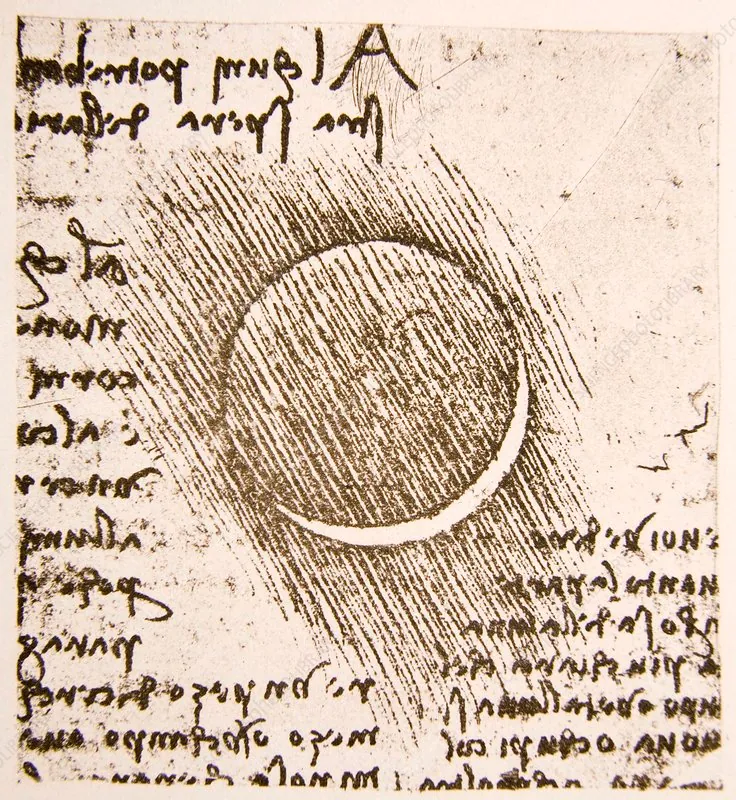 Figure i. Leonardo da Vinci’s sketch from the Codex Leicester (c. 1506–1510), folio 2r. sketched the phenomenon and offered an explanation based on light reflecting from our oceans back in the 16th century.2 Today we know that most Earthshine comes from the clouds, while the seas contribute little.
Libration
I left out lunar librationdLibration arises from the Moon’s elliptical orbit and axial tilt. At any given moment we see about 50% of the surface, but the visible portion shifts over time. in my depiction, as one of the sacrifices referred to earlier. Libration refers to the phenomenon of the visible face of the moon ‘jiggling’ somewhat as it revolves around the Earth. Around 59% of the moon’s surface is hence visible to us over time.
Reflections
A particularly interesting outcome of creating these two visualisations has been the fundamental alteration of how I perceive the moon. I no longer see a flat white disc, permanently obscured by a curiously constant cloud. A three-dimensional aspect, the satellite’s existence as a cratered sphere with depth and texture, has been firmly imprinted upon the idea of the moon that cycles through the mind. Although there are various reasons I seek to deepen my understanding of our world (if God is omniscient, would the path to the divine not be paved with knowledge?), this sort of perceptual metamorphosis is a major one.